Moz MCP: Bring Your SEO Tool Capabilities into LLMs
-min.png)
The Model Context Protocol (MCP) has opened up exciting possibilities for extending AI assistants with real-time data access. Today, we’re exploring a practical implementation: a comprehensive Moz API integration that brings professional SEO analysis directly into Claude Desktop.
IMPORTANT NOTE: This MCP Server is not official. I created it. I still get errors sometimes. You can report it on GitHub.
It’s open-source. You can use/fork/modify it anytime, anywhere.
Free MCP Server source code is here: https://github.com/metehan777/moz-mcp
The Challenge with SEO Workflow
SEO professionals typically juggle multiple tools and platforms to get comprehensive insights. You might check keyword difficulty in one tool, analyze competitor metrics in another, and then manually compile everything for analysis. This fragmented workflow breaks focus and slows decision-making.
Enter the Moz MCP Server
This TypeScript-based MCP server bridges that gap by providing 13+ specialized Moz features that connect directly to Moz’s API v3. Here’s what makes it powerful:
Core Features
- Keyword Research Suite: Difficulty scoring, search volume, intent analysis, and related suggestions
- Site Analysis: Brand authority scoring, comprehensive site metrics, and ranking keyword discovery
- Competitor Intelligence: Multi-site comparison with automated insights generation
- Smart Defaults: Automatically defaults to US locale when not specified, streamlining common use cases
The Competitor Analysis Breakthrough
One standout feature addresses a common limitation: while Moz’s API doesn’t automatically identify competitors, the server provides intelligent guidance. When analyzing a site like “metehan.ai” with target keyword “SEO,” it:
- Analyzes the primary site comprehensively
- Provides actionable competitor identification strategies
- Offers to run comparative analysis once competitors are identified
- Generates contextual insights about competitive positioning

Technical Implementation Highlights
The server handles both V2 and V3 Moz API authentication, uses JSON-RPC 2.0 for reliable communication, and implements comprehensive error handling. It leverages TypeScript for type safety and includes parallel API calls for performance optimization.
Key architectural decisions include:
-
Dual authentication support for backward compatibility
-
Intelligent error recovery with fallback strategies
-
Structured insight generation from raw API data
-
User-friendly parameter defaults (locale, engines, limits)
Real-World Impact
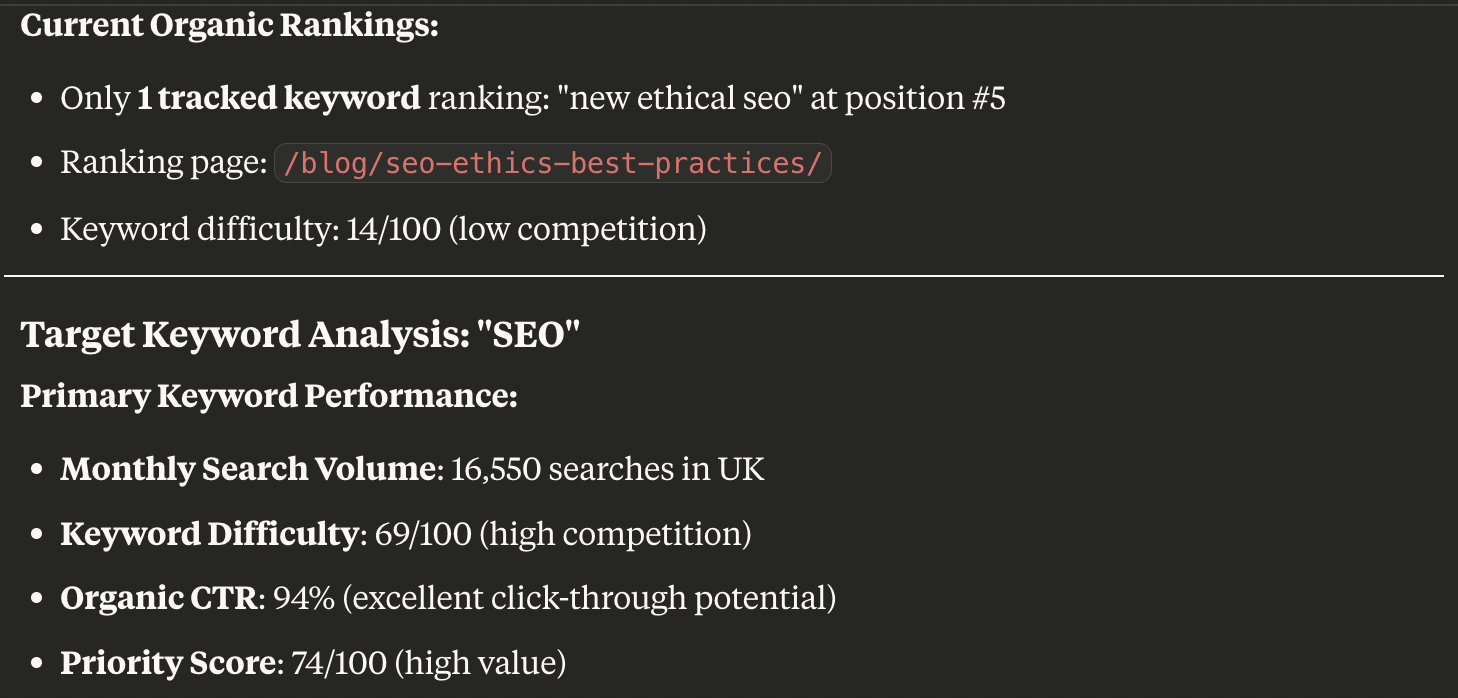
Instead of asking an AI assistant to “analyze my site’s SEO” and getting a generic response, users can now say “Analyze metehan.ai with target keyword ‘SEO’ for the US market” and receive:
- Comprehensive site metrics and brand authority scores
- Target keyword difficulty and search volume data
- Ranking keyword analysis showing current positions
- Strategic guidance for identifying and analyzing competitors
Getting Started
The server integrates seamlessly with Claude Desktop through a simple configuration file. Once set up, users can perform complex SEO analysis using natural language queries, making professional SEO insights accessible to both experts and newcomers.
This implementation demonstrates MCP’s potential to transform specialized workflows by bringing external APIs directly into conversational AI interfaces. As the MCP ecosystem grows, we can expect more tools that blur the line between AI conversation and professional data analysis.
The complete implementation showcases how thoughtful API integration can create tools that are both powerful for experts and accessible to everyone. The future of AI-powered workflows is not just about smarter responses, but about seamless access to the data that powers better decisions.
Get new research on AI search, SEO experiments, and LLM visibility delivered to your inbox.
Powered by Substack · No spam · Unsubscribe anytime