image-to-SEO: I Built an AI Tool to Decode Google Discover. Here's What It Found
-min.png)
Ever scrolled through Google Discover and wondered, “Why this article?”
As a content enthusiast, I’ve asked that too. Discover is a powerful, personalized feed—especially on mobile—and a potential goldmine for traffic. But how articles land there remains a mystery.
I had the chance to discuss this topic with many people during the BrightonSEO event.
So, I built a simple AI-powered tool: Google Discover Analyzer. It’s an image-to-SEO AI tool. It’s experimental. The Gemini AI model can detect the screen, image or images, language, headline, published/modified date(if it’s visible on the page) and entities!
The best way to use this tool is to upload a screenshot. It analyzes your article based on the page layout and the visuals you’ve included. It works with Gemini’s multimodal AI model.
I had previously released a Discover analysis tool—this one complements it with additional capabilities.
It’s free, educational, and hosted on Hugging Face Spaces—designed to analyze the characteristics that may align with Discover’s ranking signals.
Access tool here: https://huggingface.co/spaces/metehan777/image-to-google-discover
What Is Google Discover?
Unlike Google Search, Discover is a queryless feed. It proactively surfaces content based on:
- Search history
- Location
- App usage
- User interests
Getting featured here means organic reach to a highly engaged audience—especially on Android and Google apps.
⚠️ The Challenge: No Clear Rules
There’s no checklist for Discover. But based on research and Google’s guidelines and SEO experts’ experiences, strong performers often show:
- High-quality visuals
- Clear, compelling headlines (no clickbait!)
- E-E-A-T signals (Experience, Expertise, Authoritativeness, Trust)
- Topical relevance or freshness
- Good mobile usability
This led me to a question: Can AI reverse-engineer patterns from content that feels Discover-worthy?
Meet Google Discover Analyzer
A lightweight tool using Gemini AI to analyze:
- ️ Screenshots of article pages (compressed in-browser)
- Directly pasted article text
The AI is prompted to assess patterns relevant to Discover performance.
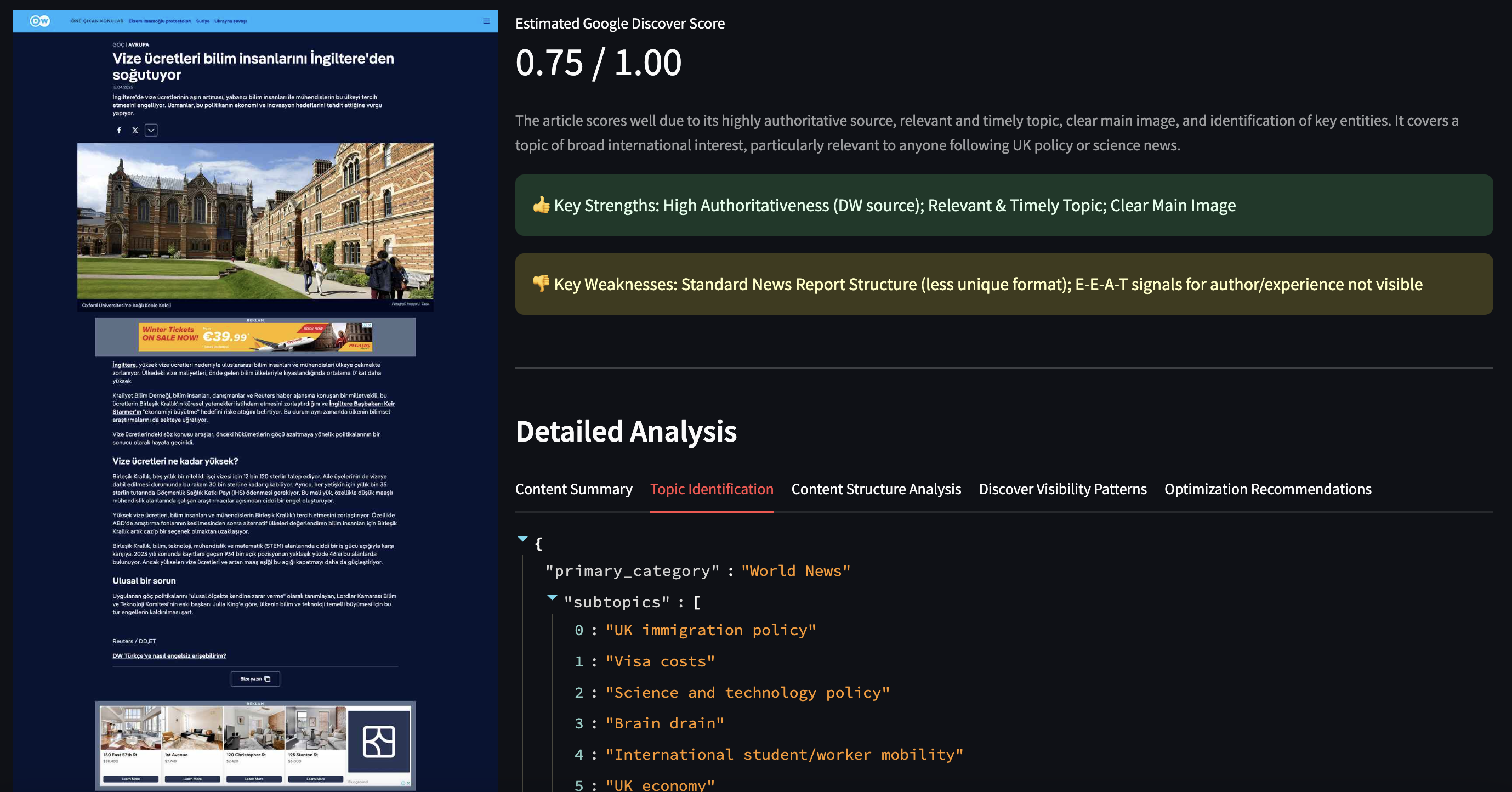
I picked a news appeared on my Discover feed. During that time, I was in London. Based on my search history, I researched a UK visa, created a route to Cambridge. It’s all before seeing this post.
⚙️ How It Works
- Input: Upload a screenshot or paste article content
- Analyze: AI (Gemini) processes the content using a structured prompt
- Output: You get a detailed breakdown and an estimated “Discover score”
What Does the Google Discover Analyzer Do?
This tool evaluates how well an article might perform in Google Discover by simulating how AI (specifically, Gemini’s multimodal model) might interpret and score your content.
You can either upload a screenshot or paste the article text. The tool then generates a Discover score (from 0.00 to 1.00) and a detailed, structured breakdown across multiple dimensions.
Example Breakdown From the Screenshots
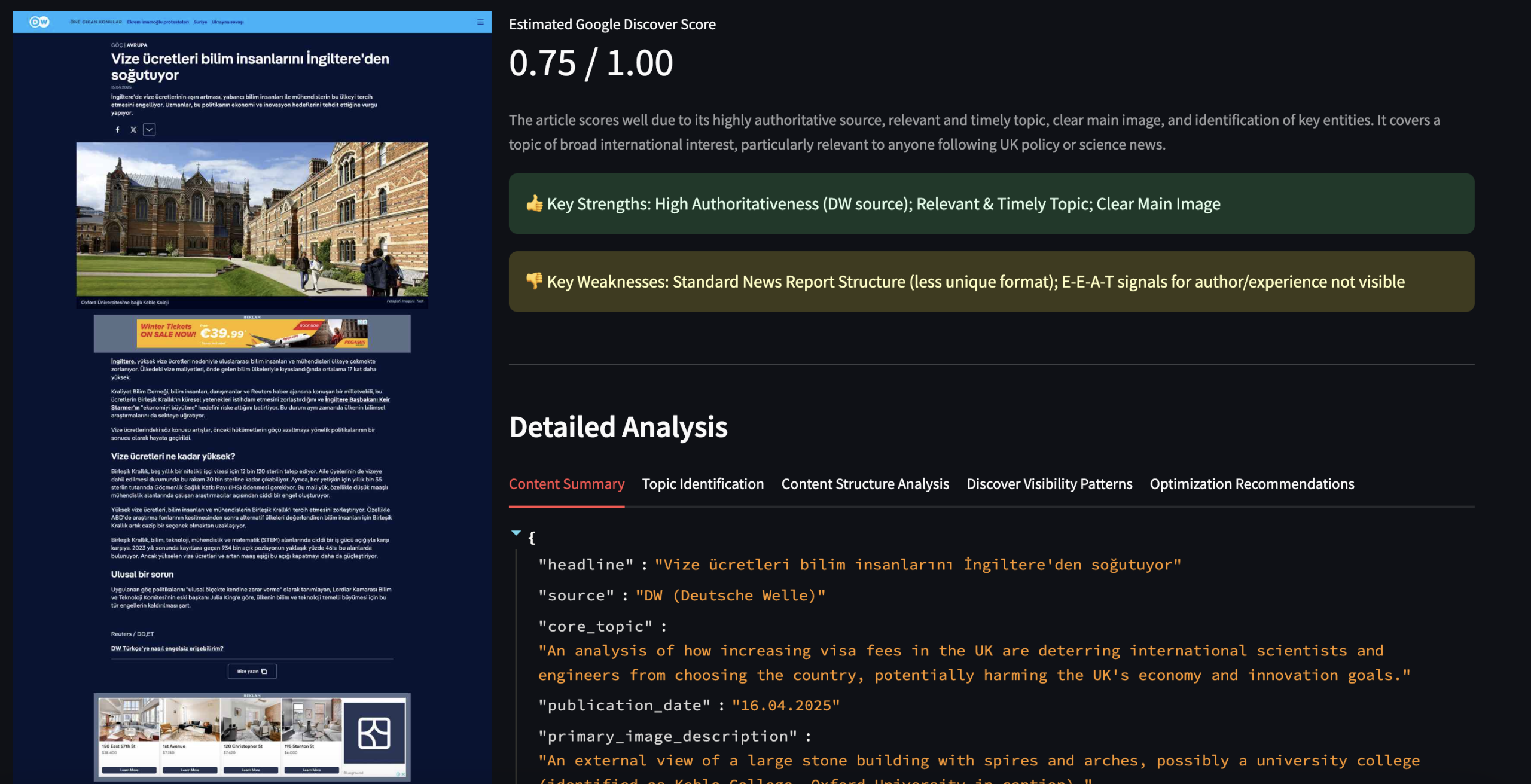
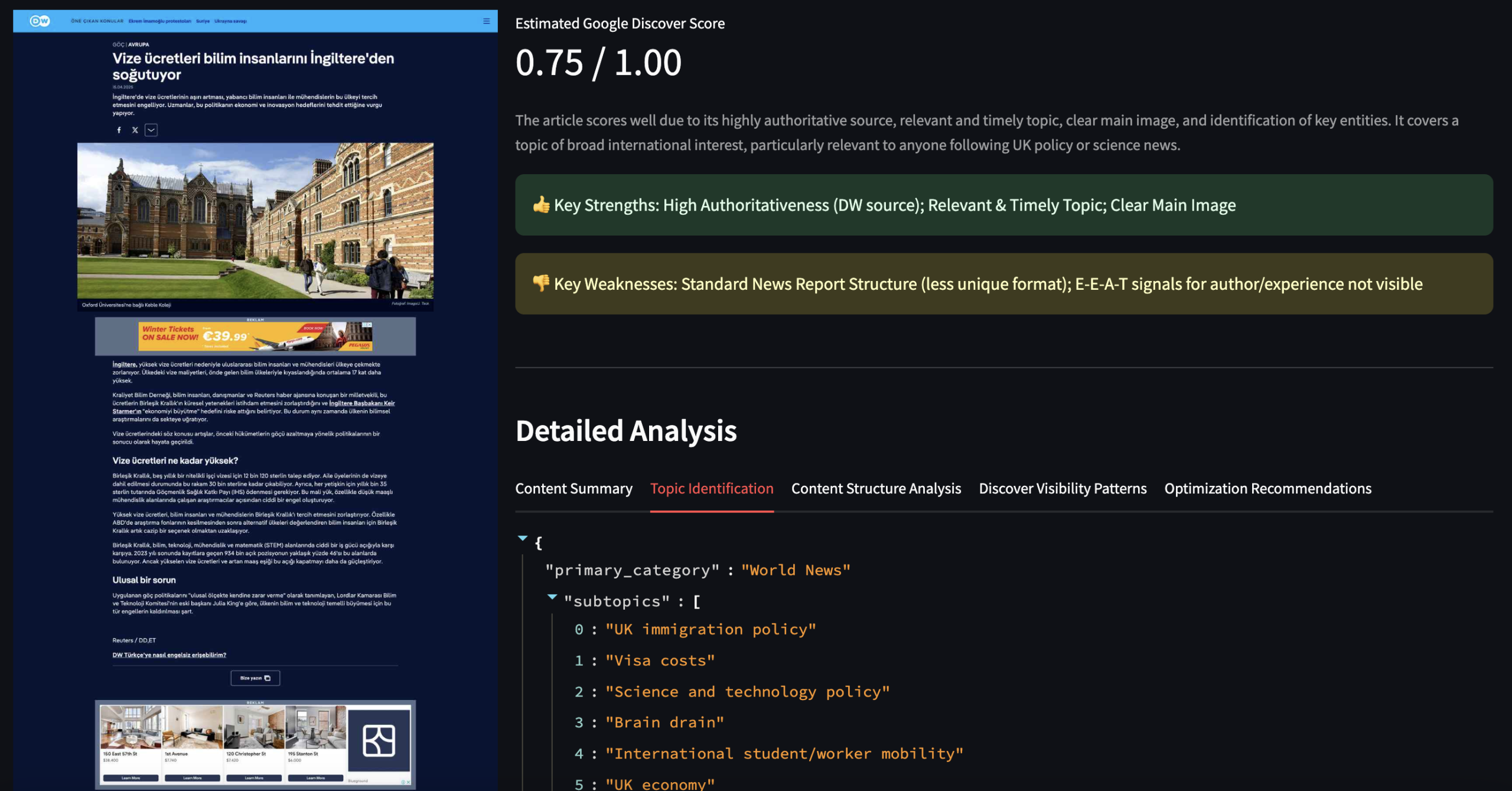
Overall Score: 0.75 / 1.00
This article scored well because:
- ✅ It’s from a high-authority source (DW – Deutsche Welle)
- ✅ It covers a timely, internationally relevant topic
- ✅ It includes a clear and informative main image
Key weaknesses:
- ⚠️ The article uses a standard news format, which might reduce uniqueness
- ⚠️ E-E-A-T signals for the author are not visible (no visible byline, credentials, etc.)
What The Tool Analyzes:
1. Content Summary
- Headline:
"Vize ücretleri bilim insanlarını İngiltere'den soğutuyor" - Publisher:
DW (Deutsche Welle) - Core Topic (in English):An analysis of how increasing visa fees in the UK are deterring international scientists and engineers from choosing the country.
2. Topic Identification
- Primary category:
World News - Subtopics identified:
UK immigration policy
- Visa costs
- Science and technology policy
- Brain drain
- International student/worker mobility
- UK economy
This structured tagging mimics how Discover may categorize and match content to user interests.
3. Content Structure Analysis
(Found in another tab not shown here, but typically includes):
- Headline format (question, list, statement)
- Presence and type of visuals
- Content length and layout
4. Discover Visibility Patterns
This part assesses:
- Timeliness of the topic
- Region and language targeting
- Alignment with current trends
- Topical authority signals (e.g., does the site often write about this subject?)
5. Optimization Recommendations
Based on Gemini’s pattern recognition, the tool suggests:
- Making the headline more unique or emotional
- Adding author credentials visibly
- Improving visual layout or image ALT descriptions
️ Why Screenshot Uploads Work Best
Because Discover is visual-first, uploading a screenshot allows the tool to:
- Evaluate layout and design
- Detect the main image
- Consider visual hierarchy and mobile readability
This is where multimodal AI shines—processing both image and text context together.
⚠️ Important Limitations
- It’s AI, Not Google: The analysis is based on Gemini’s pattern recognition—not Google’s algorithm.
- Correlation ≠ Causation: Just because a trait is common doesn’t mean it’s causal.
- Score Is Experimental: It’s a Gemini-generated number based on one internal prompt, not an official ranking factor.
Best Use? Exploration & Learning
Use it to:
- Compare content pieces
- Brainstorm optimization ideas
- Deepen your understanding of content structure
Don’t treat the score as a prediction—use it as a thinking tool.
Try It Out
Access tool here: https://huggingface.co/spaces/metehan777/image-to-google-discover
If you need the source code, just ping me on X or LinkedIn, happy to share it!
Get new research on AI search, SEO experiments, and LLM visibility delivered to your inbox.
Powered by Substack · No spam · Unsubscribe anytime