Yes, You Can Track AI Search Engines in Google Search Console! Here's the Workaround
-min.png)
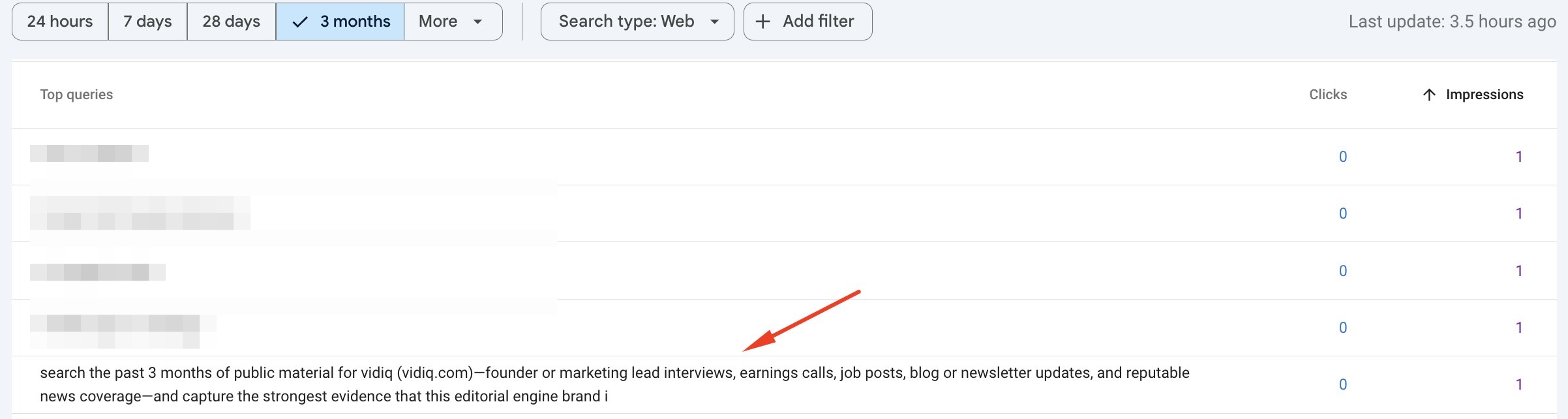
As AI-powered search engines like ChatGPT with Search, Perplexity AI, and Google’s AI Mode become increasingly prevalent, understanding their impact on your website traffic has become crucial for SEO professionals. While these AI search engines don’t identify themselves with specific user agents in Google Search Console, there’s a potential workaround to track their queries based on distinctive search patterns.
Important disclaimer: This is currently a workaround method, not an official tracking solution. The patterns identified may evolve as AI search engines update their query methods. It requires “data mining”. Start by sorting queries in ascending order by Impressions. Focus on those with 1–10 impressions, though some AI-driven queries may go up to 50. While you won’t see the exact AI engine behind each query (like ChatGPT, Perplexity, Gemini, or Claude), the patterns can still be identified.
Understanding AI Search Engine Query Patterns
Based on how AI systems conduct research and web searches, they exhibit specific patterns:
1. Comprehensive Information Gathering
AI search engines are programmed to gather complete information in a single query, leading to multi-faceted questions that humans rarely type.
2. Systematic Research Approach
When AI performs deep searches, it follows structured patterns:
- Temporal boundaries (“last 24 months”, “since 2023”)
- Current status checks (“currently developing”, “latest updates”)
- Future projections (“roadmap”, “upcoming features”)
- Competitive analysis (“market position”, “versus competitors”)
- Research, task assignment (“reply, task, research, search”)
3. Professional Terminology
AI queries often include sophisticated business language:
- Strategic planning terms
- Innovation indicators
- Market analysis vocabulary
- Technical assessment language
Live Examples from Search Console

Huge thanks to Popupsmart for this example. They are building the best no-code popup builder right now. cc: Emre Elbeyoğlu


This is from Vijay Chauhan. See here.
Enhanced Regex Patterns for AI Query Detection
Simple Solution: “Query Contains” filter on GSC
Use these one by one: reply, task, latest, research.
Temporal Research Patterns
(last|past|recent|previous)\s+\d+\s+(months?|years?|quarters?)
(since|from|between|during)\s+(January|February|March|April|May|June|July|August|September|October|November|December)?\s*202[3-5]
(2024|2025)\s+(updates?|trends?|developments?|changes?)
Strategic Business Language
strategic\s+(initiatives?|plans?|roadmap|direction|goals?)
cutting-edge\s+(technology|features?|developments?|innovations?)
innovative\s+(solutions?|approaches?|products?|services?)
Research Intent Patterns
comprehensive\s+(analysis|review|overview|assessment|evaluation)
(analyze|evaluate|assess|examine)\s+.{0,20}\s+(performance|trends?|metrics?|data)
deep\s+dive\s+(into|on|analysis|research)
Multi-Question Patterns
\?\s*(is|are|has|have|does|do)\s+.{0,50}\s*\?
\?\s*.{10,100}\s+(additionally|furthermore|also|plus)\s*
Evidence Gathering Patterns
(gather|collect|find|search)\s+.{0,20}\s+(evidence|proof|data|information|insights?)
(public|available|recent)\s+(materials?|documents?|information|data|sources?)
Current Status Queries
currently\s+(developing|working|planning|building|implementing)
(latest|current|ongoing|active)\s+.{0,20}\s+(projects?|initiatives?|developments?)
Competitive Intelligence Patterns
(competitor|competitive|market)\s+(analysis|landscape|position|intelligence)
versus\s+(competitors?|industry|market\s+leaders?)
Future-Looking Patterns
(roadmap|pipeline|upcoming|future|planned)\s+.{0,20}\s+(features?|releases?|products?)
(forecast|prediction|outlook|projection)\s+.{0,20}\s+202[4-6]
Combining Patterns for Maximum Effectiveness
The most effective approach is to look for queries that match multiple patterns:
High-Confidence AI Query Indicators (2+ matches):
- Contains temporal marker (e.g., “last 24 months”)
- Includes research language (e.g., “comprehensive analysis”)
- Has multiple questions or sub-queries
- Uses strategic business terminology
- References current year or future dates
- Exceeds 75 characters in length
Example AI Query Patterns:
- “strategic initiatives [company] launching [year] comprehensive market analysis”
- “innovative solutions currently developing last 12 months competitive landscape”
- “cutting-edge technology implementations since January [year] future roadmap”
Implementation Strategy in Search Console
Step 1: Basic Time-Based Filter
Start with queries containing temporal markers:
(last|past)\s+\d+\s+months?
Step 2: Add Strategic Language
Layer in business terminology:
(strategic|cutting-edge|innovative|comprehensive)
Step 3: Research Intent
Include research-specific terms:
(analyze|evaluate|assess|deep\s+dive|research)
Step 4: Current Status
Add present-tense indicators:
(currently|presently|ongoing|active)
Real-World Pattern Examples
Based on AI search behavior, look for queries like:
Market Research Patterns:
- “comprehensive market analysis [industry] 2024 strategic positioning”
- “innovative companies [sector] last 12 months cutting-edge developments”
Company Intelligence:
- “strategic initiatives currently implementing competitive advantage analysis”
- “deep dive [company] financial performance [year] versus industry”
Technology Assessment:
- “cutting-edge features launching [year] comprehensive technical review”
- “innovative solutions market leaders developing current roadmap”
Trend Analysis:
- “analyze trends [topic] past 6 months strategic implications”
- “comprehensive overview emerging technologies [year] market impact”
Key Indicators Summary
Primary Indicators:
- Query length > 50 characters
- Multiple distinct concepts in one query
- Temporal boundaries (months/years)
- Business/analytical language
- Multiple question marks
- Current status inquiries
Secondary Indicators:
- Strategic terminology (strategic, innovative, cutting-edge)
- Research verbs (analyze, evaluate, assess)
- Comprehensive scope words
- Future-looking language
- Competitive references
Monitoring and Optimization
- Weekly Review: Check new query patterns matching these regexes
- Pattern Evolution: AI search patterns will evolve - update regexes quarterly
- Length Analysis: Monitor average query length trends
- Vocabulary Tracking: Note new analytical terms appearing in long queries
Conclusion
This workaround provides valuable insights into AI search engine traffic by identifying their characteristic query patterns. Focus on:
- Combining multiple simple patterns rather than complex single regexes
- Monitoring queries with strategic business language
- Tracking temporal markers and research intent
- Watching for multi-part questions
As AI search engines become more sophisticated, their query patterns will evolve. Stay alert for new patterns and adjust your tracking accordingly.
**If you use BigQuery, you can identify hundreds of queries! **
Additional Resources
- Google Search Console API Documentation
- Search Console Help Center
- Regular expression testing tools for pattern refinement
Remember: This method identifies potential AI traffic based on query patterns. As the technology evolves, so too will the detection methods need to adapt.
I’ve just started my YouTube channel. I will publish specific SEO/GEO & AI new videos soon.
I will be glad if you subscribe! -> https://www.youtube.com/@metehanyesilyurtseo
Get new research on AI search, SEO experiments, and LLM visibility delivered to your inbox.
Powered by Substack · No spam · Unsubscribe anytime