How to Set Up an AI-Powered SEO Ranking Predictor (Less than $10)
-min.png)
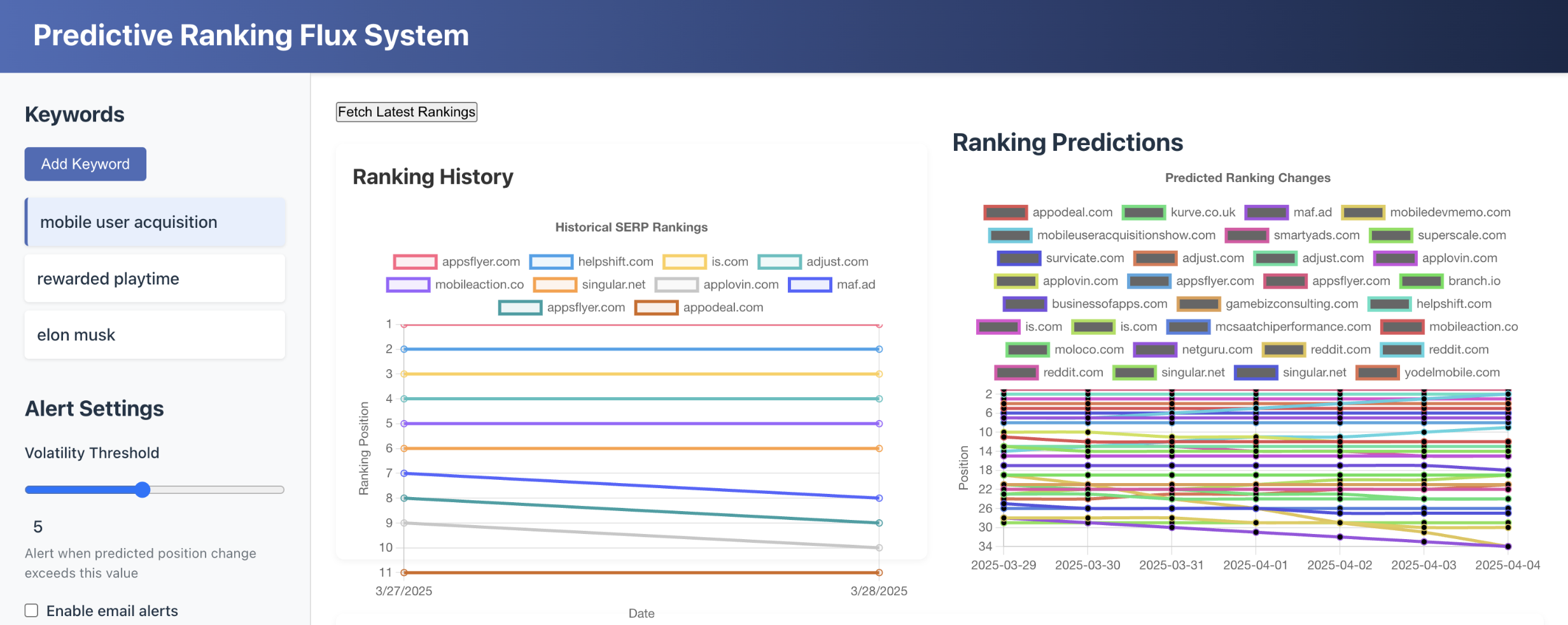
In this guide, I’ll walk through how I built a free, open-source system to track and predict search engine rankings using AI. Whether you’re an SEO enthusiast, a developer interested in AI or machine learning applications, or just curious about combining these technologies, this project might spark some ideas for your own experiments.
Why I Built This
Like many in the SEO space, I’ve often wished for better tools to understand not just what happened to my rankings, but what might happen next. Traditional SEO tools are excellent at tracking historical data, but prediction capabilities are either limited or locked behind expensive enterprise subscriptions.
I wanted to see if I could build a system that leverages open AI models (specifically Claude) to analyze ranking patterns and make educated predictions about future movements – and then share it with others who might find it useful.
Access the repo here: https://github.com/metehan777/seo-ranking-predictor
System Overview
The SEO Ranking Predictor System combines several key components:
-
Ranking data collection via SerpAPI
-
Historical data storage for pattern analysis
-
AI for predictive modeling
-
Claude AI integration for interpreting patterns
-
Visualization tools for better understanding
The beauty of this setup is that it’s modular – you can swap out components based on your preferences or available resources.
Setting Up Your Environment
Prerequisites
Before we start, you’ll need:
-
Python 3.8 or newer
-
Node.js 14+ and npm
-
A Claude API key (for the AI analysis features)
-
A SerpAPI key (for gathering ranking data) (100 search credit free for every month)
If you’re comfortable with these technologies, the setup process is straightforward.
Prediction Model
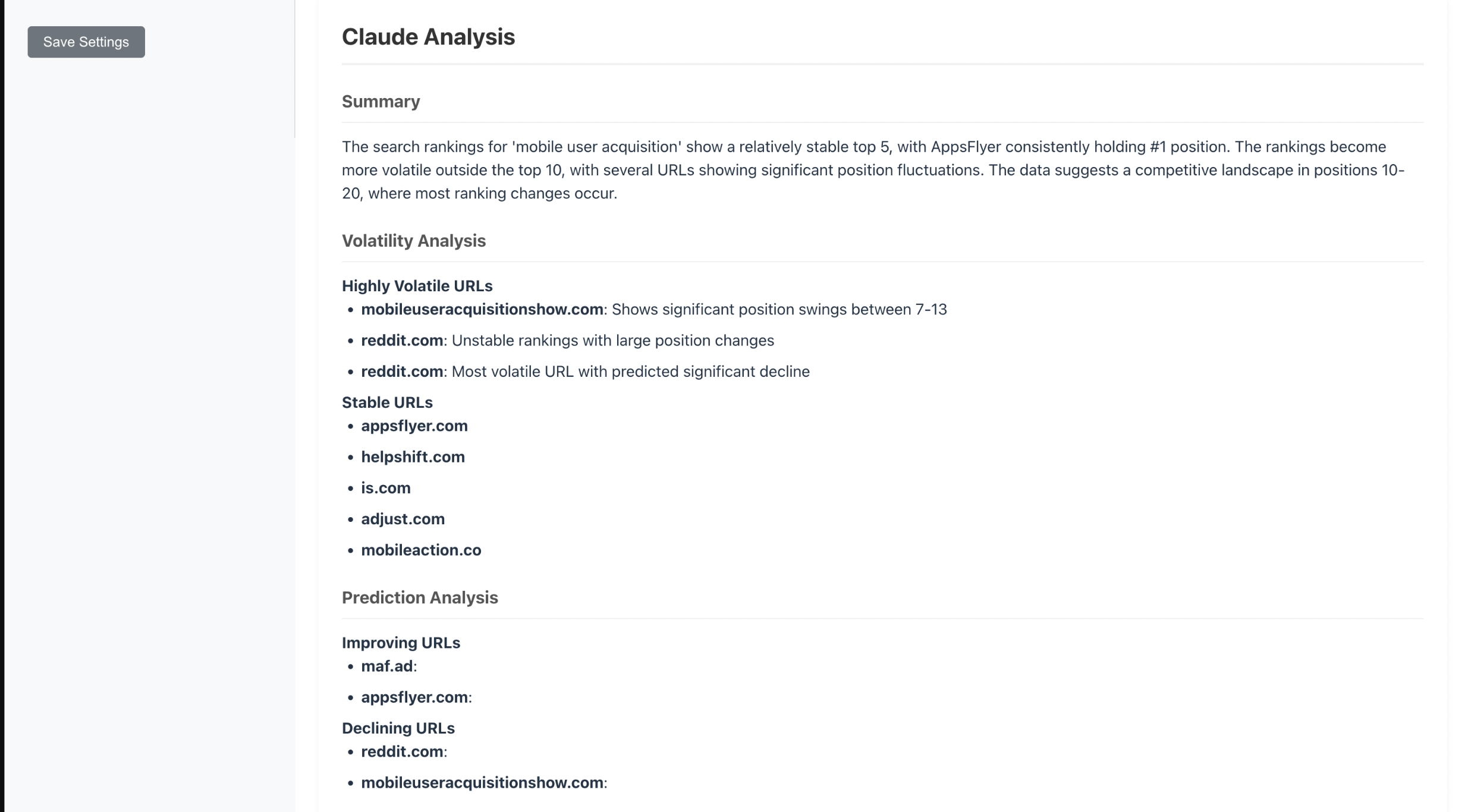
Once you have enough historical data (at least a few weeks), the system uses machine learning to identify patterns in ranking fluctuations. It considers factors like:
-
Day-of-week patterns
-
Recent momentum (up or down trends)
-
Volatility in specific keyword categories
-
Correlations between related keywords
The prediction model outputs a forecast of ranking changes for the next 7-14 days, along with confidence scores.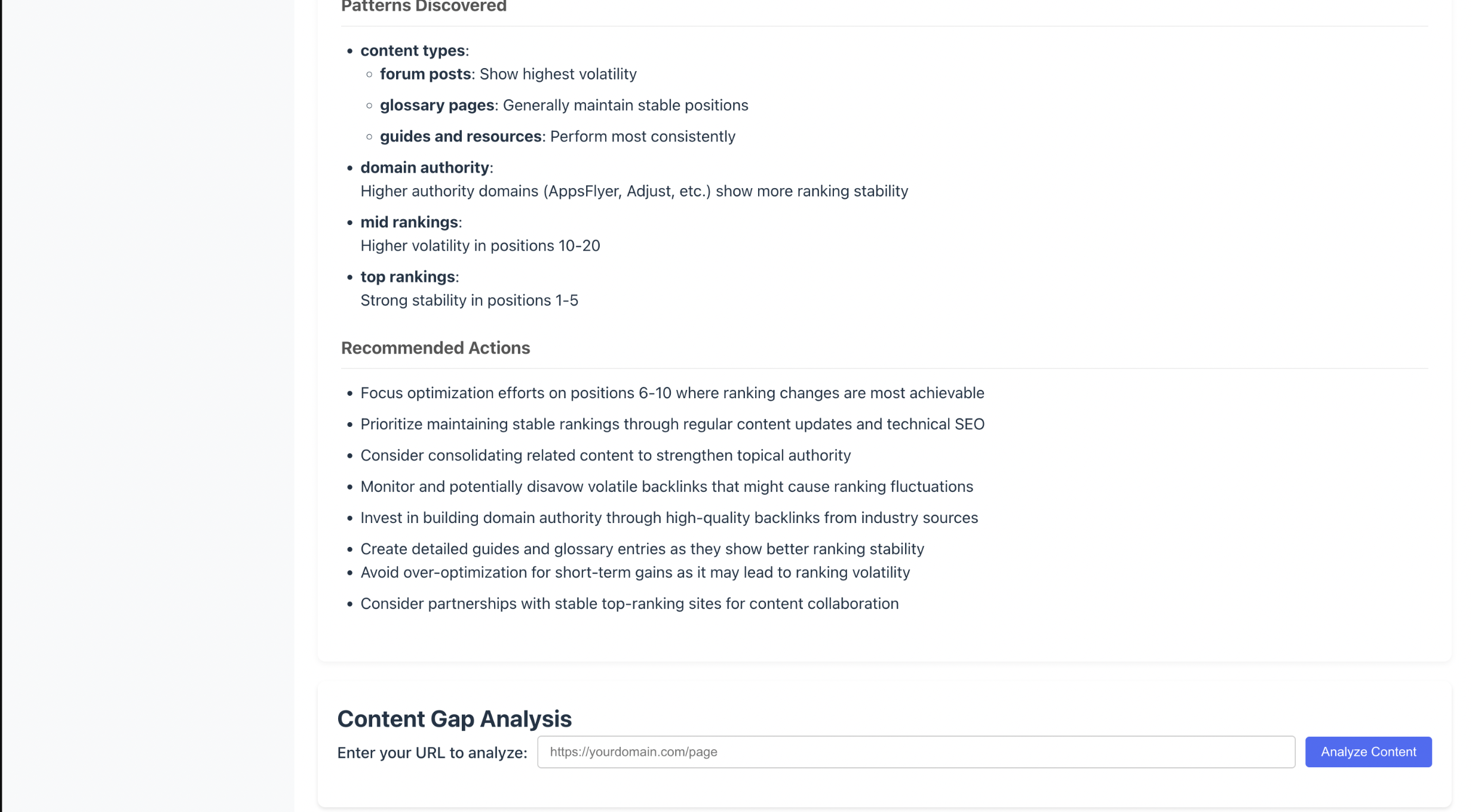 Claude AI Analysis
What makes this system unique is the Claude integration, which provides natural language interpretation of the statistical patterns:
Simplified example of AI analysis integration
defanalyze_rankings(keyword_data, predictions):
prompt = f"""
Here’s historical ranking data for ‘{keyword_data[‘keyword’]}’:
{json.dumps(keyword_data[‘history’])}
And here are the predicted changes:
{json.dumps(predictions)}
Please analyze this data and explain:
1. Why the rankings might be changing
2. What patterns you observe
3. What actions might help improve the ranking
"""
response = claude_client.messages.create(
model=“claude-3-5-sonnet-latest”,
max_tokens=1000,
temperature=0,
system=“You are an SEO expert analyzing ranking data.”,
messages=[{“role”: “user”, “content”: prompt}]
)
return response.content
Customizing for Your Needs
The beauty of an open-source project is that you can modify it for your specific requirements:
-
Add new data sources: Integrate with Google Search Console, Google Analytics, or other SEO tools
-
Customize the prediction model: If you have machine learning or AI experience, you can tune the algorithms
-
Extend the visualization: Add new types of charts or reporting views
-
Modify the AI prompts: Change how you query Claude to get different types of insights
Limitations to Be Aware Of
This system isn’t meant to replace commercial SEO tools. It has some limitations:
-
Prediction accuracy depends on the quality and quantity of your historical data
-
SerpAPI has usage costs for larger-scale tracking
-
The system requires technical knowledge to set up and maintain
-
Claude API usage has associated costs depending on your usage volume
Community Contributions Welcome
I’ve made this project open-source because I believe in collaborative learning. If you have ideas for improvements or new features, feel free to:
-
Open issues on GitHub
-
Submit pull requests
-
Fork the project for your own experiments
Conclusion
Building an AI-powered SEO prediction system might sound complex, but with modern APIs and open-source libraries, it’s more accessible than you might think. This project demonstrates how developers with SEO interests can leverage AI to gain insights that were previously available only through expensive enterprise tools.
The full code and detailed documentation are available on GitHub. I hope this project inspires you to explore the intersection of SEO, data science, and artificial intelligence in your own work.
Happy ranking!
You canjoin X discussion here, connect me on LinkedIn here.
Get new research on AI search, SEO experiments, and LLM visibility delivered to your inbox.
Powered by Substack · No spam · Unsubscribe anytime
// Comments (1)
[...] SEO Team Manager w Sempai, który podzielił się swoimi spostrzeżeniami na temat zmian w branży.Jak stworzyć predyktor pozycji SEO oparty na AI za mniej niż 10$Tworzenie predyktora pozycji w wynikach wyszukiwania opartego na sztucznej inteligencji jest teraz [...]